Europe
Ireland
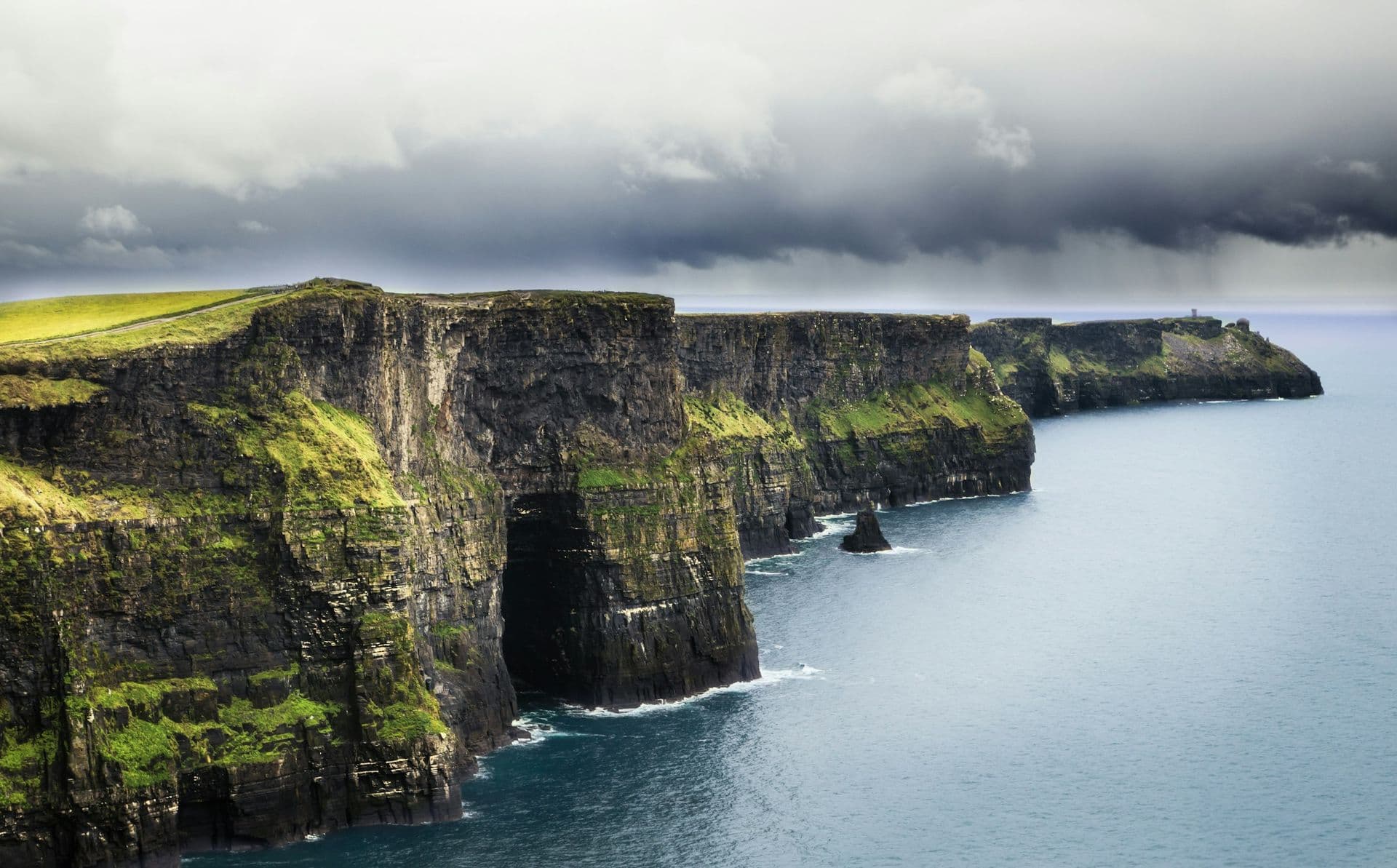
Sea cliffs, trad sessions and a pint by the fire after a day in the rain.
Ireland is small, green and easy to get around. Most backpackers land in Dublin, then loop west through Cork and Kerry to Galway, where live music spills out of the pubs every night of the week.
It is not cheap, but hostels are social and the best of it costs nothing: the Cliffs of Moher, the Burren, the Dingle peninsula and the wild coast of Connemara and Donegal. Pack a waterproof whatever the month.
Good to know
- Time zone
- GMT, GMT+1 in summer
- Plugs
- Type G, 230V
- Emergency numbers
- 112 or 999 for all emergencies
- Tap water
- Safe to drink
- Traffic drives on the
- Left
- Tipping
- Around 10% in restaurants if service is not included, but not expected in pubs.
- SIM cards
- Three, Vodafone and Eir prepaid SIMs with plenty of data cost around €15–20, and EU SIMs roam at no extra cost.
When to go to Ireland
Best months to go: May to September. Pick a month to see what it’s like.
Bars show rainfall; numbers are the average daytime high. Amber marks the best months to go.
SeptemberBest time to go
Crowds thin and the sea is at its warmest. Good walking weather.
- Daytime high
- 17°C
- Rainfall
- 70 mm
- Crowds
- Busy
| Month | Daytime high | Rainfall | Crowds | Best time to go |
|---|---|---|---|---|
| January | 8°C | 75 mm | Quiet | No |
| February | 9°C | 60 mm | Quiet | No |
| March | 10°C | 60 mm | Busy | No |
| April | 13°C | 55 mm | Quiet | No |
| May | 15°C | 60 mm | Busy | Yes |
| June | 18°C | 65 mm | Busy | Yes |
| July | 19°C | 65 mm | Peak season | Yes |
| August | 19°C | 75 mm | Peak season | Yes |
| September | 17°C | 70 mm | Busy | Yes |
| October | 14°C | 85 mm | Quiet | No |
| November | 10°C | 80 mm | Quiet | No |
| December | 8°C | 80 mm | Quiet | No |
What Ireland costs
Work out a budget for your trip, then check what everyday things cost.
$1,260for 14 days, about $90 a day (€1,100 in total)
| Cost | Per day | For the trip | |
|---|---|---|---|
| Bed | $40 | $560 | |
| Food and drink | $25 | $350 | |
| Getting around | $12 | $168 | |
| Things to do | $8 | $112 | |
| Everything else | $5 | $70 |
Per person, in US dollars. Flights and insurance not included.
What things cost
- Pint of Guinness in Dublin€7.50, about $8.62
- Cup of coffee€3.80, about $4.37
- Fish and chips from a chipper€14, about $16
- Hostel dorm bed in Dublin€40, about $46
- Dublin bus fare with a Leap card€2, about $2.30
- Bus, Dublin to Galway€18, about $21
- Cliffs of Moher entry, booked online€12, about $14
Routes through Ireland
Where to go and how long to stay, for the time you’ve got.
14 nights, 7 stops
The classic southern loop by bus and train, from Dublin through Cork and Kerry to the west coast and Galway.
Dublin
3 nights
Trinity College, the Guinness Storehouse and live music in the pubs off Grafton Street.
Kilkenny
1 night
A medieval city with a castle, a cathedral and a good pub crawl.
Cork
2 nights
The English Market, Cork’s own stout and a day trip to Cobh.
Killarney
2 nights
Cycle through the national park and the Gap of Dunloe, or tour the Ring of Kerry.
Dingle
2 nights
Drive or cycle Slea Head, then catch a trad session in town.
Doolin
1 night
Walk the cliff path to the Cliffs of Moher and explore the Burren.
Galway
3 nights
Buskers on Shop Street, oysters and music every night.
Getting around
Bus
$10–30 per leg
Bus Éireann, Expressway and Citylink link almost every town. Book online for the cheapest fares.
Train
$20–50 per leg
Irish Rail runs from Dublin to Cork, Galway, Killarney, Westport and Sligo. Advance fares are much cheaper.
Private car
$40–80 a day to hire
The easiest way to see the west and Donegal. Roads are narrow, and many firms charge extra for drivers under 25.
Ferry
$30–40 return
Ferries run to the Aran Islands from Rossaveal all year and from Doolin in summer.
What to eat and drink
Full Irish breakfast
Bacon, sausages, eggs, black and white pudding, beans and toast. Lunch sorted too.
€14, about $16
Irish stew
Lamb or beef slow-cooked with potatoes, carrots and onions. Pub food at its best.
€18, about $21
Seafood chowder
A creamy fish soup served with brown soda bread and butter, all along the west coast.
€11, about $13
Boxty
A potato pancake from the northwest, often wrapped round a filling.
€16, about $18
Spice bag
Chips, crispy chicken, peppers and onions tossed in spice, from a Chinese takeaway. A late-night classic.
€10, about $11
Guinness
The famous stout, which locals swear tastes better here. Let it settle before you drink.
€7, about $8.05
Say it like a local
A few words go a long way. Tap “Hear it” to listen, where your browser can.
Hello
Dia duit
Say it like: dee-ah gwitch
How are you?
Conas atá tú?
Say it like: kun-us uh-taw too
Thank you
Go raibh maith agat
Say it like: guh rev mah ah-gut
Please
Le do thoil
Say it like: leh duh hull
Welcome
Fáilte
Say it like: fawl-cha
Men / Women (on toilet doors)
Fir / Mná
Say it like: fir / m-naw
Cheers!
Sláinte!
Say it like: slawn-cha
Goodbye
Slán
Say it like: slawn
Questions travellers ask
Do I need to speak Irish?
No. Everyone speaks English, but you will see Irish on road signs and hear it spoken in Gaeltacht areas such as Dingle, Connemara and parts of Donegal.
Can I visit Northern Ireland too?
Yes, and there are no border checks. Northern Ireland is part of the UK, so it uses pounds sterling, and most visitors who are not British or Irish need a UK Electronic Travel Authorisation.
How do I find a good trad session?
Ask at your hostel or check the pub’s chalkboard. Sessions usually start around 9.30pm, and the best ones are often in small towns like Doolin, Dingle and Ennis.
How do I keep costs down?
Shop at Aldi, Lidl or Dunnes, cook in hostel kitchens and get a Leap Visitor Card in Dublin. There are no happy hours, because cheap drinks deals are banned.
What should I pack?
A proper waterproof jacket and shoes that can get wet, whatever the month. The weather changes several times a day, especially in the west.